
Solutions Psychiatry · Telehealth in 35 states + DC
Psychiatry that doesn't stop at stable.
Medication management and real psychotherapy from one doctorally prepared clinician, in one unhurried visit. Whether you're climbing out of a hard place or performing well and want more, the direction of the work is the same: up.
The arc of care
Care that meets you at any point on the curve.
Most practices are built for crisis and maintenance. This one is built for the whole curve: getting steady, doing the deep work, and then going further than fine.
Wherever you start, we keep going, together. The relationship doesn't end when things get better.
Combined care
Medication and therapy. Both, from one provider.
Most prescribers manage your medication and refer out the rest. Here, the person adjusting your medication is the same person doing your therapy, so nothing about you gets lost in the handoff.
Medication management
Precise psychopharmacology
Thoughtful starts, careful changes, and deprescribing when it serves you.
No five minute refills
Time to actually think, together, before anything changes.
A whole body lens
Labs, sleep, nutrition, movement, and physical health considered alongside the prescription.
Precision when it matters
GeneSight pharmacogenomic testing and targeted labs, so decisions rest on your biology, not averages.
Honest expectations
What a medication can do, what it can't, and how we'll know it's working.
Just need medication management?
PsychMed Care is our dedicated medication management practice, with 60-minute Comprehensive Initial Appointments and 30-minute Follow-up Appointments, all online. Visit PsychMed Care
Psychotherapy
Real therapy, not check-ins
IFS at the highest training level, BrainSpotting, Solution Focused Therapy, exposure work for OCD, and more.
Chosen for you
The method fits the person, not the other way around, and it adapts session to session.
Active and engaged
I ask the questions that reach beneath the surface and name the patterns keeping things stuck.
At your pace
Steady, direct, and never rushed. You stay in the driver's seat.
"One person who actually understands your full picture, instead of two people each holding a fragment of it."
Functional psychiatry
Precision tools most psychiatry never touches.
Mental health runs on biology as much as biography. These are the instruments I use to see yours clearly, so treatment is tuned to your body instead of the average body.
GeneSight pharmacogenomic testing
A simple cheek swab that shows how your genes metabolize psychiatric medications: which are likely to behave as expected, and which may need a different dose or a different choice. It doesn't pick your medication; it removes months of guessing. I'm a GeneSight provider and order it when it will genuinely change decisions. About GeneSight
Targeted labs
Thyroid, B12, folate, vitamin D, iron, metabolic and inflammatory markers: physical drivers that can imitate or amplify psychiatric symptoms. Drawn at a lab near you, interpreted in the context of your whole picture.
Evidence-guided supplementation
Where the evidence supports it: magnesium glycinate, L-theanine, N-acetylcysteine (NAC), low-dose lithium orotate, omega-3s and more, dosed and interaction-checked like any prescription, to support your medications and your nervous system. Every supplement is dispensed through Fullscript, whose catalog is independently quality-tested, so recommendations draw only from verified, highest-quality products you can rely on.
This is the engine behind the Optimize stage, and it's available at every stage of care.
The toolkit
A deep bench of methods, and the judgment to know which one you need.
Multimodal isn't a buzzword here. It's years of formal training across the approaches below, so your care never has to bend to fit the only tool available.
Internal Family Systems (IFS)Level 3
The highest tier of Internal Family Systems training. For the parts of you at war: the inner critic, the protector, the part that shuts down. Trauma, shame, and stuckness respond to this work when nothing else has.
BrainSpottingPhases 1, 2 & 5
Where you look affects how you feel. A brain-body method for trauma and performance blocks that talking around never quite reaches.
Somatic ExperiencingBody-first
Trauma and stress live in the body's responses, not just the story. We work with sensation, activation, and settling so your nervous system learns the danger is over.
Exposure & Response PreventionOCD
The gold standard for OCD, done with a steady hand and a clear map. Intrusive thoughts lose their grip when you stop negotiating with them.
Acceptance & Commitment TherapyACT
Unhook from the thought, turn toward what you value, and take the next committed step. Especially powerful for anxiety and avoidance.
Cognitive Behavioral TherapiesEvidence core
The evidence backbone: patterns, beliefs, and attention. Trauma-focused and mindfulness-based variants when they fit the picture.
Motivational InterviewingAddiction & change
For ambivalence and substance use. Change that lasts is change you chose. My job is to help you hear your own reasons clearly.
Solution Focused Brief TherapyMomentum
Small wins, concrete next steps, and evidence that you're already moving. Ideal when you want progress you can measure.
Psychodynamic & attachment workDepth
The history under the habits. How you learned to survive then, and what that strategy costs you now.
Seeking SafetyTrauma + substance use
Trauma and substance use treated together instead of in sequence. Present-focused and skills-first.
Psychedelic-assisted therapyFacilitator, CO & OR
A trained, licensed psychedelic-assisted therapy facilitator in Colorado and Oregon, the two states where this care is legal. Everywhere else: careful preparation and integration support.
Life coachingCertified (CLC)
Not everything is a disorder. As a certified life coach, I fold goals, structure, accountability, and momentum into treatment when what you need is forward motion, not just symptom relief.
What I treat
From the conditions that derail lives to the friction that limits them.
OCD & intrusive thoughts
Exposure-based care from a clinician who treats OCD as a specialty, not a sideline.
Bipolar disorder
Careful stabilization, relapse prevention, and a life that's bigger than the diagnosis.
Depression
From first episode to treatment-resistant. Medication, therapy, and the whole-body factors underneath.
Anxiety & panic
Unwinding the alarm system instead of just muffling it.
Trauma & PTSD
Internal Family Systems, BrainSpotting, and trauma-focused work for what talk alone can't reach.
ADHD
Certified ADHD specialist care: accurate assessment, honest medication decisions, real-world systems.
Addiction & substance use
Judgment-free, motivational, and integrated with your mental health care rather than split from it.
Sleep & insomnia
Because almost nothing improves while sleep stays broken.
Also: grief and loss, eating concerns, anger, stress and burnout, identity, maternal mental health, chronic illness, and more. I see older adolescents (17+), adults, and seniors, and this is an LGBTQIA+ affirming practice. Not sure where you land? Take a two-minute screener.
Check in with yourself
Free, private screeners. A few minutes to a clearer picture.
The screeners have their own page now: the same validated tools used across medicine and in my own practice (PHQ-8, GAD-7, OCI-R and six more, plus the 60-second locator), scored right on your device, never stored, and shared only if you choose to send your results at the end.
A screener is not a diagnosis. Only a full evaluation can diagnose, and a low score never means what you're feeling doesn't matter. If you are in crisis, skip the questionnaires: call or text 988, or call 911.
Tools you can use tonight
A small taste of the work.
Two tools I actually give patients. Free, right here, no signup. Consider them a preview of how practical this gets.
Pattern
Four in, four hold, four out, four hold. Steadies the nervous system fast.
Sixty seconds is one to two full rounds. If your mind wanders, that's normal; come back to the count. This is a taste of the somatic side of the work, not a replacement for it.
I need to wake up at
Age group
Ranges follow the American Academy of Sleep Medicine's age-based recommendations, and times include about 15 minutes to fall asleep. Sleep also runs in roughly 90-minute cycles, so shifting bedtime slightly to land between cycles can make mornings feel better. If falling asleep takes an hour, or racing thoughts own the night, that's treatable; insomnia care is part of what I do.
Your first visit
A real conversation, not an interrogation.
Book
Complete the intake forms, then pick a time in the booking section. Insurance is verified before your first visit, so there are no billing surprises.
The conversation
What brought you in, your history, your physical health, your sleep, what you've tried, and what a good outcome would actually look like for you. Share as much or as little as you're ready to.
Decisions, together
Will you leave with a prescription? Sometimes, when it's clearly right. Often I'd rather understand the whole picture first, because rushing that step is how people end up on the wrong medication.
A direction
You leave knowing what I think is going on, what the options are, and exactly what happens next. Not vague reassurance. A plan.
Build your prep list
Thirty seconds of taps, and you'll walk into the first visit with everything that helps.
Currently taking psychiatric medication?
Seen a psychiatric provider before?
Using insurance?
What brings you in? Tap all that apply.
All packed. See you at the first visit.
Straight talk
Six myths, flipped.
Tap any card. These are the beliefs that keep good people from getting great care.
About Karel
Two decades in medicine. All of it in the room with you.
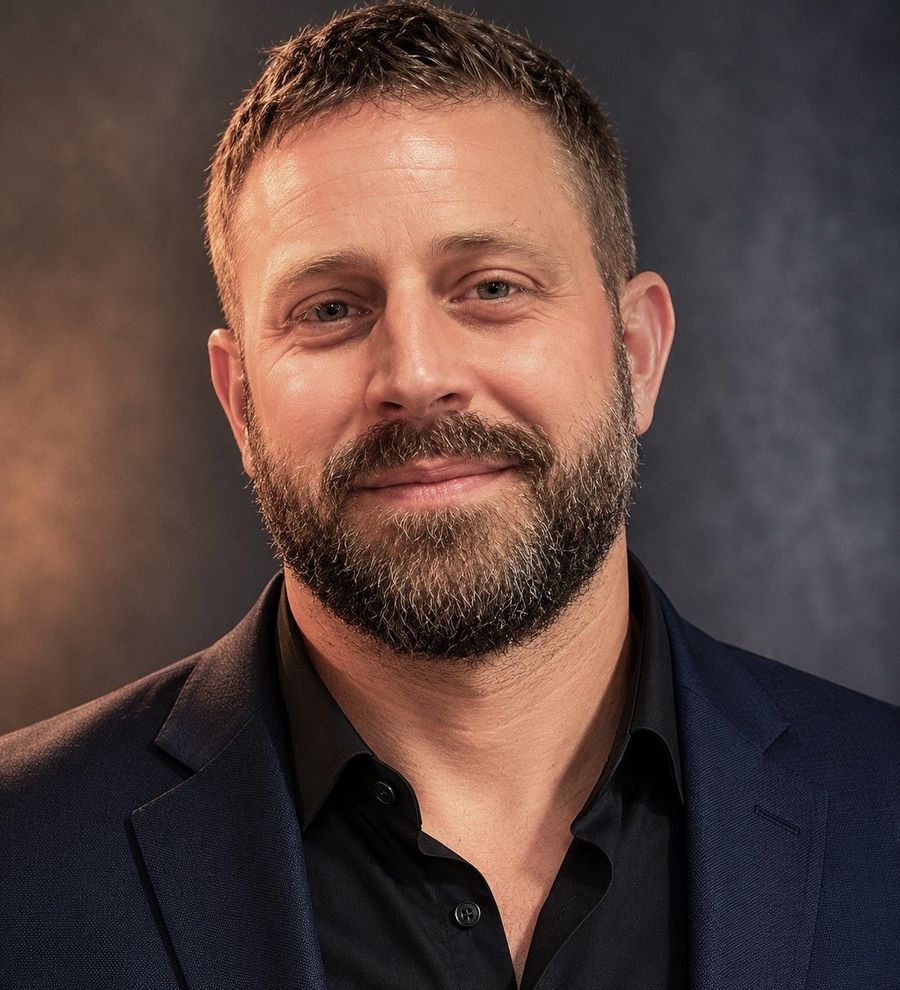
I came to psychiatry the long way: podiatric medicine in England, then diagnostic sonography, including seven years at California's largest county hospital, a Level I trauma center, where I read hearts, vessels, and unborn patients while teaching the next class of sonographers. Then acute inpatient psychiatry. Then this practice. I've seen the body from the inside out, and it changed how I treat the mind. Your labs, your sleep, your nutrition, and your nervous system aren't side notes to your mental health. They're the terrain.
I built Solutions Psychiatry to be the practice I couldn't find: one clinician doing real therapy and precise medication management in the same unhurried visit, licensed across the country so your care doesn't end when your zip code changes. I see older adolescents (17+), adults, and seniors.
The training never stops, because your care shouldn't plateau. A doctorate from Vanderbilt, the highest level of Internal Family Systems training, BrainSpotting, anger management, trauma, ADHD, autism spectrum, and addiction work, with Vanderbilt's family practice program in its final stretch and the Institute for Functional Medicine curriculum underway.
He/him. Direct when it helps, gentle when it matters, and honest always.
Doctorate & graduate education
Therapy training
Specialty certifications
A former life in the body
In training now
Coverage
Licensed in 35 states and Washington DC. In network with the majors.
All visits are secure video. Type your state to check instantly, or tap it on the grid.
Select or type a state to check coverage.
National networks
The Blue Cross Blue Shield family
Regional plans
Medicare & Medicaid
Credentialing expands constantly, so this list only grows. Your specific plan is verified before your first visit. Not sure? Email [email protected] with your plan name and I'll check.
On Medicare? How Medicare coverage works at this practice, in Arizona, California, Colorado, Texas and Utah.
Don't see your plan? Check out-of-network benefits
If your insurance isn't listed above, you may still be covered. Many plans reimburse out-of-network care, and this checks yours in about a minute, right here, secure and HIPAA compliant.
Powered by Mentaya
Fees & logistics
Simple, transparent, verified up front.
New patient evaluation
$350 self-pay
A comprehensive first visit: your history, your health, and a clear direction by the end.
Follow-up Appointment
$250 self-pay
Never a rushed refill. Even medication-focused visits, about 30 minutes, include brief solution-focused therapy.
With insurance
$0 to $40 typical copay
The range for the majority of plans, though it varies. Your individual insurance is verified before the appointment, so you'll know your exact copay in advance.
Visit type
How you'll pay
Your plan
Your estimate
$350
All-inclusive and transparent. No facility fees, no surprise balance later.
Hours (Central Time)
- Mon
- 7:00 am to 7:00 pm
- Tue
- 7:00 am to 7:00 pm
- Wed
- Closed
- Thu
- 7:00 am to 7:00 pm
- Fri
- 7:00 am to 7:00 pm
- Sat
- 7:00 am to 1:00 pm
- Sun
- Closed
Contact
Questions
The short answers.
Do you do therapy or medication management?
Both, in the same visit, from the same person; that's the heart of this practice. Some patients work with me for medication management only, and others transition from combined care to medication-only over time. Even medication-focused visits, about 30 minutes, still include brief solution-focused therapy and the same whole-person attention, just in a more compact form. Either way, you get both worlds. If you want medication management only, that care lives at PsychMed Care, our dedicated medication management practice.
Is everything virtual?
Mostly, yes. Visits run on secure video across 35 states and DC, and your care continues if you move. One exception: for patients prescribed controlled substances, federal and DEA requirements call for one in-person visit each year in most states. This practice is telehealth by design, so I meet patients in person, in the state where they are, to satisfy those requirements. It is always arranged together well in advance, never a walk-in office visit.
Do you take my insurance?
I'm in network with Aetna, Cigna, UnitedHealthcare and Optum, the Blue Cross Blue Shield family across more than a dozen states, Oscar, Oxford, Carelon, Providence, and many more, plus Medicare in Arizona, California, Colorado, Texas, and Utah, and Medicaid in Oregon and Wyoming. Every plan is verified before your first visit; copays for the majority of plans land between $0 and $40, and you'll know your exact number up front.
Will I get a prescription at the first visit?
Sometimes, when it's clearly the right call and you're comfortable. Often I'd rather use the first appointment to understand the full picture before starting or changing anything. We decide together, and nothing happens without your understanding.
Who do you work with?
Older adolescents (17 and up), adults, and seniors. People rebuilding from a hard place, and high performers who are functioning well and want to function better. This is an LGBTQIA+ affirming practice.
Do you offer genetic testing or lab work?
Yes. I'm a GeneSight provider for pharmacogenomic testing, a cheek swab that shows how your genes affect medication metabolism, and I order targeted labs: thyroid, B12, folate, vitamin D, iron, and metabolic markers that influence mental health. Where the evidence supports it, I also use supplements like magnesium glycinate, L-theanine, N-acetylcysteine, and low-dose lithium orotate to support treatment.
What if I'm in crisis right now?
Call or text 988 (Suicide & Crisis Lifeline) or call 911. Solutions Psychiatry is not an emergency service, and getting you immediate help matters more than anything on this page. Full crisis resources, including state-specific lines and LGBTQIA+ and veteran options, are in the crisis section just below.
Nothing matches that yet. Try a different word, or just email [email protected].
If you're in crisis
Right now, help is three taps away.
You don't need an appointment, a diagnosis, or the right words. Pick whichever way of reaching out feels easiest. These services are free and answer around the clock.
In immediate danger? Tap to call 911The Trevor Project, for LGBTQIA+ young people
Veterans Crisis Line
Resources for your state
While you decide, steady the body
Name 5 things you can see, 4 you can feel, 3 you can hear, 2 you can smell, and 1 you can taste. Then breathe with me for sixty seconds.
Open the 60-second breatherIf any number ever fails, 911 always works. Solutions Psychiatry is not an emergency service, and reaching out to any of these is a strong move, not a setback.
Book
Choose a time. Everything else is handled.
Scheduling runs on IntakeQ. Three quick steps: sign the treatment intention agreement, share your preferred days and times, then complete the intake forms and consents. When those are done, pick any open slot in the calendar below; returning patients can head straight to it.
Set the intention
Two minutes. The intention we start from, what I commit to you, and what the work asks of you. Your signed, dated copy files into your chart.
Choose your preferred times
Tap the days and times that fit your life. Your preferences file into your chart, so scheduling can match you.
Complete your intake forms
The Patient Intake Form and Consents unlock scheduling and take about ten minutes.
Open intake formsScheduling access
Request Access to Self-Schedule
Self-scheduling opens with an access code. Email [email protected] or text (800) 303-3221 to request one.
The scheduler is taking a moment to load. Open it directly instead:
Questions first? [email protected] or (800) 303-3221.
"You won't leave with vague reassurance. You'll leave with a direction."
Your Preferred Days & Times
Tap everything that fits your life. Your choices file straight into your chart, so scheduling can match you before you ever open the calendar.
Your time zone
Preferred days
Preferred times
The Treatment Intention Agreement
This is a treatment intention agreement: the intention we start from, what I commit to you, and what the work asks of you. Nothing here is fine print, and nothing here is about money; billing, scheduling policies, privacy notices, and formal consents live in your intake forms, where they belong. Every line here has one purpose: your outcome. Read it, then sign at the bottom.
The intention we start from
By signing, you are voluntarily choosing to pursue mental health and wellness care at Solutions Psychiatry and to work, together, toward goals we define and refine as a team. You authorize your Solutions Psychiatry clinician to provide the services we together consider necessary and advisable. For patients under 18, a parent or legal guardian also consents and signs. Care is always a choice, and it stays your choice.
What I commit to you
- Unhurried visits where you're a person first, never a time slot.
- Evidence-based, whole-person care: therapy and medication under one roof, labs and testing when they'll change decisions, and honest answers about what I recommend and why.
- Straight talk. If something isn't working, I'll say so, and we'll adjust together.
- Your honesty will always be met with problem-solving, never judgment.
- A deliberately small practice, so the attention you receive is real.
What this work asks of you
I can be genuinely helpful, but only with the full picture. The more openly you share, the better your care gets. So this is the heart of the agreement:
- Be as open and honest with me as you can. I cannot treat what I cannot see.
- Show up. Attend your scheduled appointments; they are the engine of your progress.
- Work the plan we build together. Treatment here is a joint design, not a prescription handed down. If part of it isn't working for you, tell me and we'll redesign it.
- If medication is part of your plan, take it as prescribed, and if you stop or change it, tell me. There is no penalty for honesty here, ever. Knowing you've stopped a medication is vital clinical information, and telling me is the responsible move, not a confession.
Medication history access: the one non-negotiable
You consent to my accessing your medication history through prescription records and monitoring systems. This is the single non-negotiable in this practice, and here is the plain reason: I cannot prescribe safely, catch dangerous interactions, or optimize your medications and supplements without an accurate, current picture of what's in your body. It's the same reason a pilot never skips the pre-flight checklist. If you prefer not to consent to this, I respect that completely, and it means Solutions Psychiatry isn't the right practice for your care.
Staying active: the 90-day standard
I intentionally cap how many patients I take on. That is what makes individualized, specialist-level care possible, and it means every spot on my active panel is limited and spoken for by a waitlist. Meaningful psychiatric care requires momentum, so active care here means at least one appointment every 90 days.
If 90 days pass without a visit, then on day 91 your care with Solutions Psychiatry concludes automatically and your panel spot passes to someone on the waitlist. This is not a punishment, and it does not mean anything is wrong with you. It simply means this style of care isn't the right fit for you right now, and that's okay; life has seasons. If you later reach a point where engaged, momentum-based care is the right step, you're warmly invited to request to re-establish care. I'll be honest: a spot isn't guaranteed, because spots go to those ready to use them.
So there are no surprises, here is exactly what happens if care concludes this way: this agreement serves as your advance written notice of the policy; you'll receive a closure notification; your records transfer promptly to any new provider on request; refills after closure are handled through your primary care provider, urgent care, or an emergency department; and crisis support never closes: 988 and 911 are available day and night.
Missed appointments
Your appointment time is reserved entirely for you, which means it is unavailable to anyone else, and appointments are where the work actually happens. So one clear expectation: three missed appointments within 12 months concludes care automatically. After that, medication refills are handled through your primary care provider, urgent care, or an emergency department while you arrange care elsewhere. Not a judgment; stewardship of limited specialist care. Cancellation windows and scheduling logistics are covered in your intake forms.
This is outpatient care
Solutions Psychiatry is an outpatient practice: no 24-hour coverage, no crisis team, no emergency response. If you are in crisis, in danger, or having thoughts of harming yourself or someone else, use acute services first, before anything else: call or text 988, call 911, or go to your nearest emergency room. Contacting this office is never a substitute for emergency care, and waiting for a reply could cost time you need. Your safety plan comes first, always.
What to expect, honestly
Done well, this work reduces distress, improves relationships, sharpens coping, and builds a life you're not just surviving. It is also a marathon, not a quick fix: progress takes time, effort between sessions, and honest course corrections, and no ethical clinician can guarantee outcomes. What I can guarantee is my full attention, the best available evidence, and a plan we adjust until it fits.
Ready? Sign below. Your signature means you've read this, had your questions answered, and are choosing this work voluntarily, as a partner in it. A signed, dated copy files directly into your chart.
Typing your full legal name acts as your electronic signature.
Date:
Opens the official signature form; it takes about a minute and files straight into your chart.